


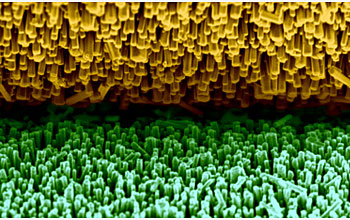
 If you see yourself taking an unwanted trip to the ER anytime in the next decade or so, there's a fairly decent chance you'll end up with at least one or two creepy creatures perusing some aspect of your innards. As if mechanical beings cruising through your intestines wasn't eerie enough, a team of Georgia Tech researchers have proposed a new way to constantly monitor one's blood pressure. The aptly-dubbed nanowires take advantage of the "piezoelectric effect in semiconducting zinc oxide" in order to detect minute forces as tiny "as a few piconewtones," or about the same amount needed to unzip a strand of DNA. The specially designed sensors will purportedly enable robotic nurses to continually monitor your blood pressure to take action before things get too out of hand, and of course, the "biocompatible "system would beam results wirelessly to devices in hospitals or even wrist-mounted readers so you'd know when to pop a proverbial chill pill. This should definitely suffice as a "second opinion," eh?
blood etiketine sahip kayıtlar gösteriliyor. Tüm kayıtları göster
blood etiketine sahip kayıtlar gösteriliyor. Tüm kayıtları göster
19 Mart 2014 Çarşamba
Georgia Tech researchers design nanowires to monitor blood pressure
If you see yourself taking an unwanted trip to the ER anytime in the next decade or so, there's a fairly decent chance you'll end up with at least one or two creepy creatures perusing some aspect of your innards. As if mechanical beings cruising through your intestines wasn't eerie enough, a team of Georgia Tech researchers have proposed a new way to constantly monitor one's blood pressure. The aptly-dubbed nanowires take advantage of the "piezoelectric effect in semiconducting zinc oxide" in order to detect minute forces as tiny "as a few piconewtones," or about the same amount needed to unzip a strand of DNA. The specially designed sensors will purportedly enable robotic nurses to continually monitor your blood pressure to take action before things get too out of hand, and of course, the "biocompatible "system would beam results wirelessly to devices in hospitals or even wrist-mounted readers so you'd know when to pop a proverbial chill pill. This should definitely suffice as a "second opinion," eh? 

Piezoelectric nanowires could lead to blood-powered iPods, cellphones
 You know what'll be awesome? Actual end products resulting from this presumably nonstop research on piezoelectric nanowires. Yet again we're hearing of a new group of researchers that have figured out a way to harness electricity from life's simplest things: walking, a heart beating or even the flowing of blood. Put simply, the gurus have discovered how to use zinc oxide nanowires in order to generate an electric current when "subjected to mechanical stress." The difference here, however, is that these critters could actually be implanted under the skin, though the scientists have made quite clear that there isn't a timetable for commercial production. In other words: yawn.
[Via textually, image courtesy of NSF]
Kaydol:
Kayıtlar (Atom)